
Article source: Data Ape
An industry veteran’s journey to AI transformation
What happens when a company with 27 years of IT industry experience embraces large AI models? Teamsun’s answer is BidUltra, an AI-native application that has made a significant impact on the traditional bidding market just 18 months after its launch.
At WAIC 2025, Teamsun showcased several enterprise AI offerings, including BidUltra 2.0, Intelligent Voice Bot, Smart Campus Solutions and One-Stop AI Delivery Services.
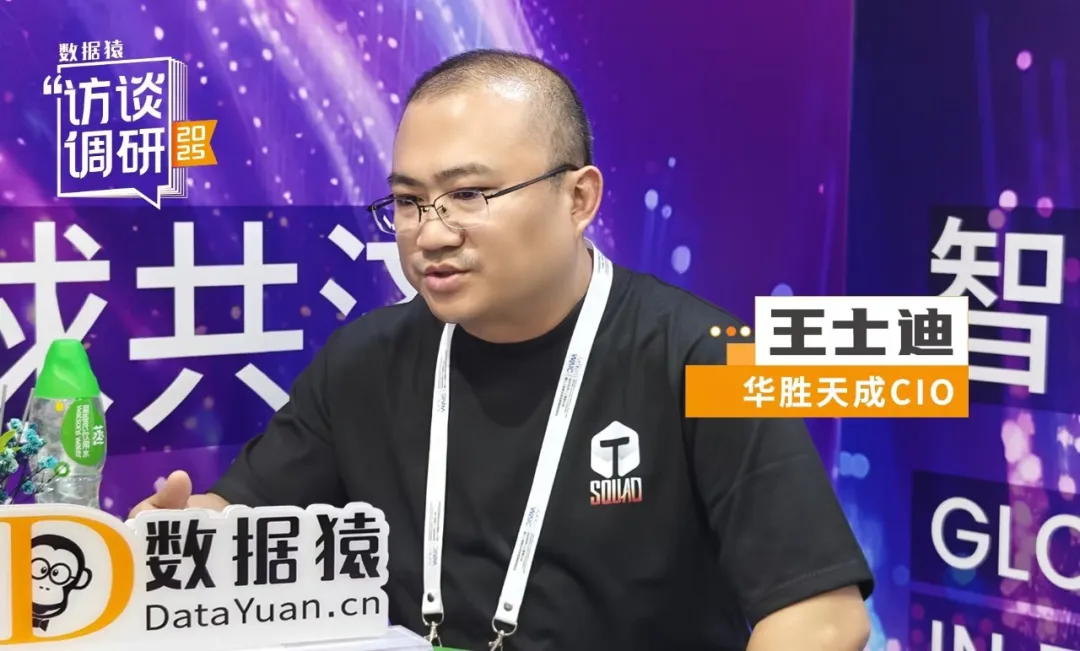
Teamsun has transformed from a traditional systems integrator into an AI-native application company. What strategic considerations drove this change, and what challenges did the company encounter? Data Ape interviewed Teamsun CIO Wang Shidi to discuss how the company is building on its strengths in the AI era.
An industry veteran’s path to AI transformation
AI is often seen as the exclusive domain of technology giants and fast-moving startups, an image that may appear inconsistent with Teamsun’s mature and measured style. Since its establishment in 1998, Teamsun has been known as a provider of enterprise IT solutions and cloud services, serving key industries such as government, finance, telecommunications and energy. Its history, business scope and customer base have given the company a reputation for substantial, mission-critical work rather than experimentation.
But this is just an illusion.
Wang Shidi said that Teamsun was among China’s earliest systems integrators and solution providers.
Innovation has been part of Teamsun’s culture since its founding. As the company grew, each major technology shift became an opportunity for a new stage of development. When large models emerged as a disruptive force in 2023, Teamsun quickly adopted a strategy centered on AI transformation.
Transformation brings uncertainty and risk. Asked about Teamsun’s progress, Wang Shidi described the transition as a natural result of the company’s accumulated capabilities.
1. Nearly 30 years of industry experience
Teamsun has worked in IT and digital services for 27 years. That experience spans multiple economic and technology cycles and has given the company deep technical expertise, a strong talent base, market insight and a thorough understanding of enterprise requirements. Building AI-native innovation on this foundation allows Teamsun to move faster and more effectively.
2. Focus on the right markets
Choosing which track to enter is the first question that must be answered.
Wang Shidi noted that AI will reshape almost every industry, but companies must still decide what to pursue and what to leave aside. Teamsun evaluates opportunities according to two principles:
1. Return on investment. Time, attention, funding and other resources are limited. Entering too many fields would dilute those resources, so Teamsun selects markets that match its capabilities and offer the greatest potential to create value.
2. Customer demand. Regardless of its form, technology must ultimately deliver value to customers. Customer needs are therefore the starting point for AI product development. Clear pain points indicate both a willingness to adopt a solution and the potential to pay for it; technology developed without real demand risks becoming disconnected from the market.
3. A broad ecosystem supports AI implementation
The main obstacle to AI implementation is often not the technology itself, but finding the right application. Teamsun has two important ecosystem advantages. First, as a systems integrator, it offers full-stack capabilities covering computing power, large models and scenario applications, enabling one-stop AI delivery. Second, its long-standing work in government, finance, telecommunications, energy and other sectors has created a strong, trusted customer base. These advantages help Teamsun introduce AI products into new scenarios efficiently.
Teamsun selected bidding, campus management and contact centers as three priority scenarios for enterprise AI development. The transformation has already produced tangible results, with BidUltra emerging as a flagship product that has attracted substantial market attention.
BidUltra 2.0 arrives
Bringing AI to the entire bidding process
Imagine an office at three in the morning: sales colleagues checking bid documents word by word, the legal team debating contractual terms, technical staff reviewing detailed specifications, and papers piled across the table. This is a familiar picture in traditional bidding. BidUltra is designed to turn that bidding marathon into a sprint.
Bidding, an important part of the market economy, is undergoing major change. Policy and regulatory updates, technological innovation and an evolving market environment are making the sector more compliant, transparent and digital. In 2025, revision of China’s Tendering and Bidding Law was added to the legislative agenda, further raising compliance requirements. Bid documents are also evolving from tactical documents into clearer expressions of business value.
In response, Teamsun launched BidUltra 2.0 at WAIC 2025. The product integrates AI agent technology throughout the bidding process, covering tender document interpretation, resource matching, intelligent knowledge libraries, bid verification, response analysis and bid writing. It significantly improves efficiency and win rates, helps companies avoid disqualification risks, and makes bidding more intelligent, efficient and secure.
Why did Teamsun choose bidding as a priority scenario despite its broad business portfolio?
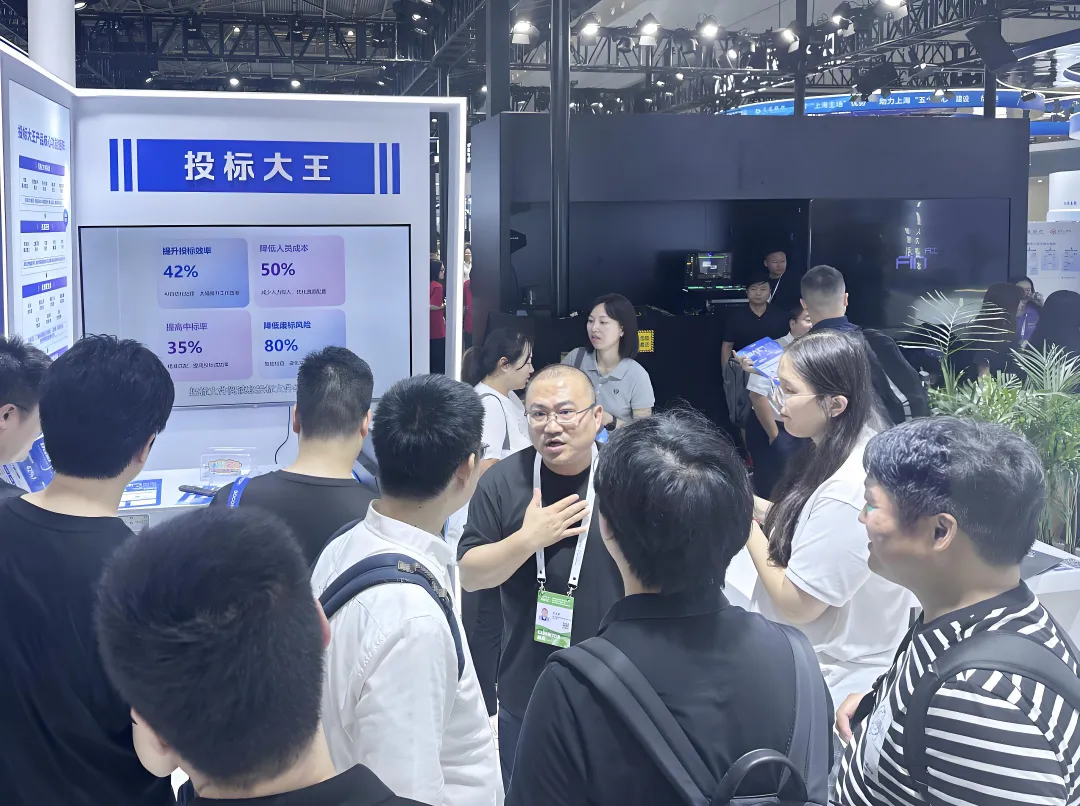
The Teamsun booth at WAIC 2025
Wang Shidi explained that Teamsun has a natural advantage in bidding. The company participates in thousands of bids each year, creating a substantial internal workload and a wealth of practical experience. Many key members of its research, development and product teams have more than 20 years of bidding experience and understand the most important stages and user requirements. That knowledge forms the core of BidUltra.
BidUltra is designed around the entire bidding workflow rather than documents alone. It uses large-model technology to simulate how bidders think and work, breaks the process into structured steps, and generates content according to that workflow.
BidUltra has been deployed by multiple enterprises, including major centrally administered state-owned enterprises. In practice, BidUltra 2.0 can reduce tender document interpretation from one day to ten minutes, bid review from four days to two hours, and bid writing from one week to one day, significantly improving efficiency and win rates.
From internal beta to versions 1.0 and 2.0, BidUltra has undergone multiple iterations in just 18 months, reflecting both Teamsun’s agile innovation and rapidly evolving market demand.
Wang Shidi said that BidUltra 2.0 is a standardized product serving three main types of bidding: goods, services and engineering. Future versions will extend into additional industries and specialized scenarios, supported by more products designed for vertical markets.
Moving beyond the era of large platforms
“Moving beyond the era of large platforms” is a prominent statement on Teamsun’s website. It reflects an important change as the digital economy enters the age of large models: value creation and distribution are moving from centralized platforms toward more distributed collaboration.
Large AI models require a different implementation approach from traditional software. Teamsun has adopted customer co-creation as a central part of that approach.
Wang Shidi said Teamsun’s customer co-creation model is built on trusted relationships developed through more than 20 years of industry experience. The company uses those relationships as a foundation for innovation within existing services, combining continuity with change.
Teamsun contributes technology, platforms and industry expertise, while customers contribute data and scenario knowledge. Combining these strengths through joint development accelerates practical AI implementation.
In many vertical fields, such as finance, law firms, accounting firms and other service organizations, Teamsun is continuing to promote the integration of AI and industry scenarios. Taking private investment research as an example, Teamsun is using AI technology to reshape the report production paradigm.
As an integrator, Teamsun has natural ecosystem advantages that continue to play a distinctive role in the era of large models.
Wang Shidi described every partner in the large-model industry as a key component of a wider value map. Teamsun seeks to build a complete ecosystem rather than maximize the gains of any single company. This requires participants to align around outcomes, share capabilities openly and replace zero-sum competition with collaborative development.
As the IT industry enters an intelligent transformation cycle, Teamsun has chosen to embrace change. Its 2023 strategic transformation marked the company’s evolution from a traditional IT service provider into an AI-native ecosystem builder.

Amid the AI wave, Teamsun neither follows trends blindly nor rests on its past achievements. Instead, it is converting deep industry experience into momentum for innovation. While many companies are still considering how to adopt AI, Teamsun has already developed its own path through customer co-creation and ecosystem collaboration.

- Scan the QR code for business consultation -




Tel:010-80986666 (集团)
Zip code:100193
Email:marketing@teamsun.com.cn
Headquarter: Building 23, East District, No.10 Northwest Wang East Road, Haidian District, Beijing